
Key Takeaways
- Android commands 72.77% of the global mobile operating system market as of late 2025, according to Command Linux (2025).
- Over 20% of U.S. firms expect to use AI in the first half of 2026, according to the Federal Reserve (2026).
- Alphabet’s capital expenditures were projected to rise significantly in 2026 for AI infrastructure, data centers, and custom chips, according to Anmol Kohli on Medium (2026).
- The UAE leads global AI usage, with 70.1% of working-age adults regularly using AI tools in Q1 2026, according to Visual Capitalist (2026).
- Google Antigravity 2.0 provides a standalone desktop application and SDK for agent-first development, integrating with Google AI Studio and Firebase.
Are you ready to unlock the future of intelligent mobile experiences? The latest Google I/O 2026 AI Android Updates have ushered in a transformative era, fundamentally shifting Android from a mere operating system to an integrated intelligence system. This article will provide a comprehensive recap of the essential announcements, detailing how Google’s AI-first strategy will reshape developer workflows and everyday user interactions.
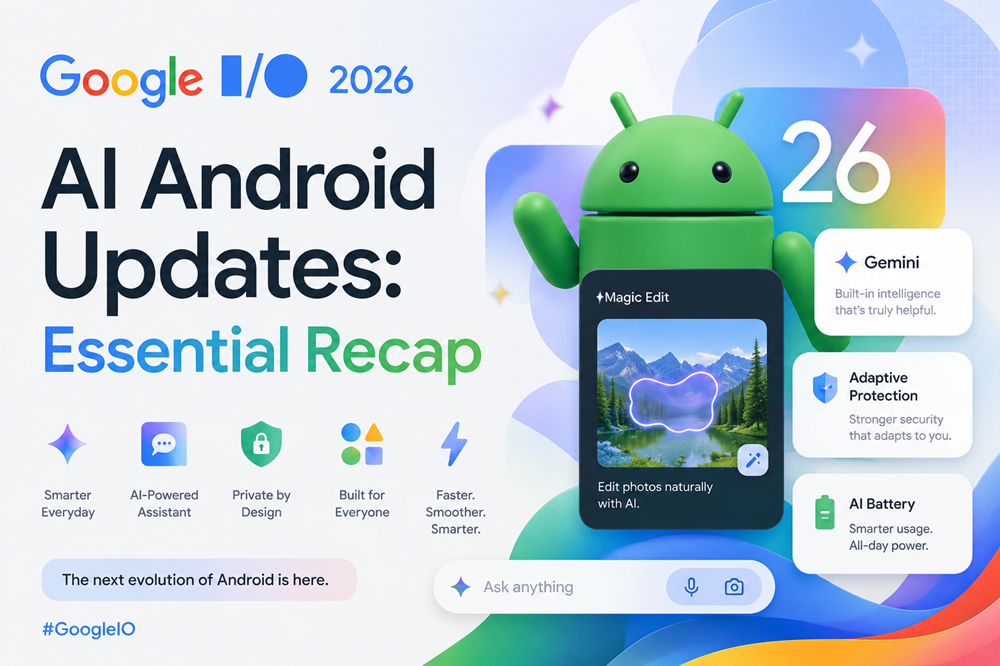
Quick Answer: Google I/O 2026 unveiled an “intelligence system” for Android, powered by new Gemini models and the Antigravity platform. Key updates include Android 17 features, XR capabilities, and advanced developer tools for intelligent, adaptive applications.
What Were the Biggest Google I/O 2026 AI and Android Updates?
The biggest Google I/O 2026 AI Android Updates centered on a monumental shift towards an “intelligence system” for Android, deeply integrating advanced AI across the entire ecosystem. This strategic pivot was highlighted by Google’s Android Developers Blog (2026), emphasizing a foundational change in how developers will build and users will interact with their devices. Sundar Pichai, Google CEO, reinforced this vision, stating, “AI is one of the most important things humanity is working on.”
The event showcased significant advancements in Gemini models, the introduction of the Google Antigravity agent-first development platform, and a suite of innovative features within Android 17. These announcements collectively redefine mobile intelligence and user experience, setting a new benchmark for device capabilities. The comprehensive Google I/O 2026 AI Android Updates signal a future where devices are proactively intelligent, anticipating user needs and streamlining complex tasks.
Here are the core pillars of the Google I/O 2026 AI Android Updates:
- Gemini Model Expansion: New models like Gemini 3.5 Flash and Gemini Omni were unveiled, offering enhanced capabilities for developers and end-users alike. Gemini 3.5 Flash is now generally available via Google Antigravity and Google AI Studio, outperforming Gemini 3.1 Pro on challenging coding benchmarks.
- Google Antigravity Platform: This new agent-first development platform provides a standalone desktop application and SDK, allowing developers to orchestrate and build sophisticated AI agents. The Google Antigravity platform represents a critical tool for leveraging the latest Google I/O 2026 AI Android Updates.
- Android 17 Features: The next iteration of Android introduces groundbreaking features such as Screen Reactions, improved native Instagram support, a redesigned Android Auto, and the “Continue On” feature for seamless task transfer between devices.
- Android XR Development: Google revealed significant progress in Android XR, emphasizing immersive experiences and developer tools for extended reality applications. This area saw substantial Google I/O 2026 AI Android Updates, pointing to future innovations in spatial computing.
- AI-First Development Tools: New APIs and SDKs were introduced to facilitate AI-first development, empowering developers to integrate intelligent experiences directly into their applications. These tools are central to realizing the full potential of Google I/O 2026 AI Android Updates.
Diving Deep into Google's New AI Features from I/O 2026
Google’s I/O 2026 introduced a powerful array of new AI features designed to make Android devices more intuitive and capable than ever before. Central to these advancements is the expanded Gemini family of models, which are now more accessible and powerful for developers, according to the Google Blog (2026). These Google I/O 2026 AI Android Updates underscore Google’s commitment to pushing the boundaries of artificial intelligence.
The latest Gemini models are engineered for diverse applications, from enhancing user productivity to enabling complex agentic behaviors. For instance, Gemini 3.5 Flash is specifically optimized for speed and efficiency, making it ideal for real-time interactions and low-latency applications. This focus on practical, performant AI is a hallmark of the Google I/O 2026 AI Android Updates.
Key AI features announced include:
- Gemini 3.5 Flash: This model is the first in Google’s latest series, combining frontier intelligence with action capabilities. It is generally available via Google Antigravity, the Gemini API in Google AI Studio, and Android Studio, demonstrating superior performance on coding and agentic benchmarks compared to its predecessors.
- Gemini Omni: Positioned as a multimodal powerhouse, Gemini Omni aims to understand and process information across text, images, audio, and video more seamlessly. This broad capability is crucial for creating truly intelligent, context-aware applications within the Google I/O 2026 AI Android Updates framework.
- Gemini Spark: Designed as a 24/7 personal AI agent for Gemini Enterprise and Workspace customers, Gemini Spark autonomously assists users with tasks such as writing emails or creating study guides. This agentic capability exemplifies the shift towards proactive AI assistance.
- AppFunctions (Android MCP): A new API that allows developers to expose app functionalities directly to Gemini, enabling the AI to invoke specific app actions based on user prompts. This deep integration is a cornerstone of the Google I/O 2026 AI Android Updates for developers.
These innovations reflect Google’s strategy to embed AI deeply into the fabric of the Android ecosystem, making devices more intelligent and responsive. The advancements represent a significant leap in enabling agent-first development.
Android 17: What's New for Users and Developers?
Android 17 brings a host of new features and improvements that enhance both user experience and developer capabilities, solidifying the integration of AI throughout the operating system. These significant Google I/O 2026 AI Android Updates mark a pivotal moment for the platform, making it more intuitive and powerful, according to the Android Developers Blog (2026). The focus is clearly on creating a more adaptive and intelligent mobile environment.
For users, Android 17 introduces functionalities that streamline daily tasks and enrich multimedia interactions, while developers gain new tools to build more engaging and intelligent applications. This dual focus ensures that the benefits of Google I/O 2026 AI Android Updates are felt across the entire ecosystem.
Notable Android 17 features include:
- Screen Reactions: This new feature allows users to record selfie reactions while simultaneously screen recording, offering a novel way to create engaging content. This enhances the interactive capabilities of Android, leveraging new hardware and software integrations.
- Improved Native Instagram Support: Android 17 provides deeper, more optimized integration with Instagram, leading to a smoother and richer user experience within the popular social media application. This addresses a common user request, improving app performance and stability.
- Redesigned Android Auto UI: The Android Auto interface has been completely redesigned to scale seamlessly to any car screen size, offering a consistent and intuitive experience across diverse vehicle models. This update significantly improves usability for drivers.
- “Continue On” Feature: Similar to Apple’s Handoff, this feature allows users to seamlessly transfer tasks between different Android devices, such as continuing an email draft from a phone to a tablet. This enhances productivity and device interoperability.
- Enhanced Security and Privacy: Android 17 introduces advanced security protocols and privacy controls, giving users greater transparency and command over their data. Securing user information remains a top priority for Google, as evidenced by these Google I/O 2026 AI Android Updates.
These updates are designed to make Android 17 a more capable and user-friendly operating system, while also providing developers with the tools needed to innovate within this new AI-centric framework. The Pixel 9 and future Pixel devices are expected to fully leverage these capabilities.
Google Antigravity: Powering the Agent-First Future
Google Antigravity is Google’s groundbreaking new platform for agent-first development, designed to empower developers to build sophisticated AI agents that can orchestrate complex tasks. This platform represents a critical component of the Google I/O 2026 AI Android Updates, shifting the paradigm from app-centric to agent-centric interactions, according to the Google Blog (2026). The goal is to enable AI to proactively assist users across multiple applications and services.
This platform provides the infrastructure and tools necessary to create intelligent agents that can understand context, make decisions, and take actions on behalf of users. It’s a foundational element for realizing the vision of Android as an “intelligence system.”
Google Antigravity provides:
- Standalone Desktop Application: A dedicated application for developers to design, test, and deploy AI agents, streamlining the development workflow. This tool is essential for harnessing the power of Google I/O 2026 AI Android Updates.
- Antigravity SDK: A comprehensive Software Development Kit that offers programmatic access to the same agent harness powering Google’s own products. This allows for deep integration and customization of agent behaviors.
- Integration with Google AI Studio and Firebase: Seamless connectivity with existing Google developer tools, making it easier to leverage Gemini models and backend services for agent development. This integration simplifies the creation of powerful, scalable agents.
- Agent Orchestration Capabilities: Tools to manage and coordinate multiple AI agents, enabling them to work together to achieve more complex goals. This is crucial for building robust, multi-faceted intelligent systems.
The Google Antigravity platform is set to revolutionize how applications are built, moving towards a future where AI agents act as intelligent intermediaries between users and their digital world. Rob Enderle, a tech analyst, noted that Google’s aggressive AI strategy “signals a far more disruptive AI era than most companies appear prepared for,” suggesting an “extinction event for standalone apps” as agents take over. The Google I/O 2026 AI Android Updates directly support this paradigm shift.
How Will Gemini AI Transform Android Devices in 2026?
Gemini AI is set to profoundly transform Android devices in 2026 by embedding deep intelligence directly into the operating system and applications, making interactions more personalized and efficient. This integration is a cornerstone of the Google I/O 2026 AI Android Updates, elevating Android from an operating system to an “intelligence system,” as stated by the Android Developers Blog (2026). The goal is to make every interaction smarter and more intuitive.
The power of Gemini, particularly models like Gemini 3.5 Flash and Gemini Nano 4, enables devices to understand context, anticipate user needs, and execute complex tasks with minimal input. These capabilities will be evident across all aspects of the Android experience, from device management to content creation.
Here’s how Gemini AI will transform Android devices:
- Proactive Device Management: Gemini will intelligently manage device resources, battery life, and notifications, learning user patterns to optimize performance without constant manual adjustments. This makes the device feel more responsive and efficient.
- Enhanced Personalization: AI-powered personalization will go beyond simple recommendations, offering deeply customized experiences based on user habits, preferences, and real-time context. This includes dynamic home screens and adaptive app suggestions.
- Advanced Multimodal Interactions: Gemini’s multimodal capabilities will allow users to interact with their devices using natural language, gestures, and even visual cues, leading to a more seamless and intuitive user interface.
- Intelligent Content Creation and Editing: Features like those seen on the Pixel 9, such as Magic Editor and Best Take for photo editing, will be more widely available and enhanced by Gemini’s understanding of content. The Pixel 9 AI capabilities, powered by Gemini, demonstrate the potential for creative assistance.
- Seamless Cross-Device Experiences: With features like “Continue On,” Gemini will facilitate fluid transitions of tasks and content between Android phones, tablets, and other connected devices. This creates a unified digital experience across the user’s ecosystem.
The integration of Gemini AI is not just about new features; it’s about fundamentally rethinking how users interact with technology, making devices more like intelligent companions. These Google I/O 2026 AI Android Updates promise a future where your Android device is always one step ahead.
Exploring Android XR and the Future of Immersive Experiences
Android XR represents Google’s significant push into extended reality, laying the groundwork for future immersive experiences that blend the digital and physical worlds. These Google I/O 2026 AI Android Updates highlight Google’s strategic investment in spatial computing, aiming to establish Android as a leading platform for virtual, augmented, and mixed reality applications. The future of interaction extends beyond flat screens.
The development of Android XR focuses on creating robust developer tools, optimized hardware integration, and a seamless user experience for a new generation of immersive devices. This initiative is crucial for Google to maintain its leadership in mobile technology as the computing paradigm evolves.
Key aspects of Android XR development include:
- Unified Platform for XR: Android XR aims to provide a consistent operating system and development environment across various XR hardware, from VR headsets to AR glasses. This standardization simplifies development and broadens market reach.
- Developer SDKs and APIs: Google introduced new SDKs and APIs specifically designed for Android XR development, enabling creators to build rich, interactive 3D experiences. These tools are vital for fostering innovation within the XR space.
- AI-Powered Immersion: Gemini AI will play a pivotal role in Android XR, enhancing realism, optimizing performance, and enabling intelligent interactions within immersive environments. This includes AI for context awareness, object recognition, and natural language processing in 3D spaces.
- Hardware Partnerships: Google is collaborating with hardware manufacturers to ensure Android XR is optimized for next-generation devices, promising high-fidelity graphics and responsive tracking. This collaboration is essential for delivering compelling user experiences.
- Focus on Practical Applications: Beyond gaming and entertainment, Android XR is being developed with an eye towards practical applications in education, enterprise, and productivity, leveraging immersive technology to solve real-world problems.
The continued evolution of Android XR, propelled by the Google I/O 2026 AI Android Updates, signals Google’s long-term vision for computing. As Demis Hassabis, CEO of Google DeepMind, referenced by Sundar Pichai, suggested, future AI will be “very, very powerful,” and XR will be a key interface for these advanced intelligences.
Long-Term Impact: Google's AI-First Strategy Beyond 2026
Google’s AI-first strategy, powerfully demonstrated by the Google I/O 2026 AI Android Updates, positions the company for significant long-term impact across the technology landscape, fundamentally reshaping how users interact with digital services. This strategic direction, articulated by Sundar Pichai, who stated, “The future of AI is not about replacing humans, it’s about augmenting human capabilities,” aims to integrate AI into every facet of Google’s offerings, from search to cloud services. The Google I/O 2026 AI Android Updates are not merely incremental changes but foundational shifts.
This approach will not only enhance Google’s product ecosystem but also set new industry standards for intelligent, adaptive technology, influencing competitors and driving innovation for years to come. The investment reflects a deep commitment to an AI-driven future.
The long-term implications include:
- Redefining User Expectations: Users will come to expect more proactive, personalized, and seamless interactions from all their devices and services, pushing other tech companies to adopt similar AI-first strategies. This raises the bar for digital experiences.
- Shift in Developer Focus: Developers will increasingly concentrate on building agentic capabilities and leveraging AI models, moving away from traditional app-centric development. The Google Antigravity platform will be central to this shift. You can read more about integrating AI features in existing products here.
- Increased AI Infrastructure Investment: Alphabet’s capital expenditures were projected to rise significantly in 2026 for AI infrastructure, data centers, and custom chips like Ironwood, according to Anmol Kohli on Medium (2026). This investment signals a sustained commitment to AI dominance.
- Competitive Advantage: Google’s early and aggressive adoption of an AI-first strategy, as noted by Rob Enderle, gives it a substantial lead in developing truly intelligent systems, challenging rivals like Apple and Microsoft. Android commands 72.77% of the global mobile operating system market as of late 2025, according to Command Linux (2025), providing a massive platform for AI deployment.
- Ethical AI Development: As AI becomes more pervasive, Google’s commitment to responsible and ethical AI development will become even more critical, influencing industry standards and public trust.
The Google I/O 2026 AI Android Updates are a clear signal of Google’s vision for an augmented future, where AI serves as a powerful co-pilot for humanity. This strategic direction will shape the technological landscape well beyond 2026.
Frequently Asked Questions
What were the biggest announcements at Google I/O 2026?
The biggest announcements at Google I/O 2026 included the shift of Android to an “intelligence system,” new Gemini models like 3.5 Flash and Omni, the Google Antigravity agent-first development platform, and significant Android 17 features. Over 20% of U.S. firms expect to use AI in the first half of 2026, according to the Federal Reserve (2026), reflecting the broader industry trend Google is leading. These updates collectively redefine mobile technology and developer opportunities.
What new AI features did Google announce at I/O 2026?
Google announced several new AI features at I/O 2026, prominently featuring Gemini 3.5 Flash for enhanced performance, Gemini Omni for advanced multimodal understanding, and Gemini Spark as a personal AI agent for enterprise users. These features are designed to embed deep intelligence across the Android ecosystem, making devices more intuitive. The UAE leads global AI usage, with 70.1% of working-age adults regularly using AI tools in Q1 2026, according to Visual Capitalist (2026), highlighting the global demand for such innovations.
What’s new in Android 17?
Android 17 introduces Screen Reactions, improved native Instagram support, a redesigned Android Auto UI that scales to any car screen size, and a “Continue On” feature for seamless task transfer between devices. These updates enhance user experience and leverage AI for more fluid interactions. Android is projected to maintain between 71% and 73% global market share in 2026, according to Command Linux (2025), ensuring these features reach billions of users.
How will Gemini AI integrate with Android devices?
Gemini AI will integrate with Android devices by powering proactive device management, enhancing personalization, enabling advanced multimodal interactions, and facilitating intelligent content creation. The Pixel 9, for example, already showcases Gemini AI for features like Magic Editor and AI-powered task automation. This deep integration aims to transform Android into a truly intelligent system that anticipates user needs.
What is Google Antigravity?
Google Antigravity is a new agent-first development platform that provides a standalone desktop application and SDK for building sophisticated AI agents. It allows developers to orchestrate and create agents that can take actions on behalf of users, integrating with Google AI Studio and Firebase. This platform is a cornerstone of Google’s strategy to move beyond traditional app-centric interactions towards an agent-driven future.
The Google I/O 2026 AI Android Updates have firmly established Google’s vision for an AI-first future, transforming Android into a dynamic intelligence system. From the powerful new Gemini models and the innovative Google Antigravity platform to the user-centric features of Android 17 and advancements in Android XR, the announcements signal a new era of intelligent computing. Developers and users alike can anticipate a more intuitive, powerful, and seamlessly integrated digital experience. Embrace these groundbreaking changes and start exploring how these Google I/O 2026 AI Android Updates will redefine your interaction with technology.

