

Artificial intelligence has given SaaS companies a real chance to grow faster, improve margins, and make their products more useful in everyday workflows. This is why so many teams he moved quickly to launch copilots, assistants, automations and agents over the past year.
But speed created another problem; many companies rush AI into their products before they figure out how it should be marketed:
- Some add it to existing plans, blurring the value of their base offering;
- Some give it away too early and train customers to expect more for the same price;
- Others build pricing pages around credits, add-ons, and premium tiers that make perfect sense internally and almost no sense to the buyer.
This tension is now increasingly present in the market.
At the beginning of 2026, more than 1 trillion dollars the SaaS market cap has been wiped out as investors question how AI will affect traditional software models, particularly those tied to per-seat pricing.
At the same time, prices across SaaS was moving how vendors are responding to rising computing costs, changing usage patterns, and stronger pressure to more closely align price with value delivered.
This is where the real challenge begins. Adding artificial intelligence to a product is only the first step. Wrapping it up so that customers understand that value and want to pay for it is where the hard work begins.
Read below how SaaS companies can sell AI features without undermining the product that customers have come to trust.
The cannibalization trap and why so many SaaS companies fall into it
This is what cannibalization looks like in SaaS:
- A new feature, add-on, or level of AI will start to draw customers away from a stronger offering instead of bringing them closer to one;
- A business starts something new and expects to expand, only to find that the price has made it difficult to justify the existing product.
This is happening more often than many teams expect because in 2026 AI feels urgent. It’s so easy to focus on delivering a feature and assume that the price can be adjusted later. But once customers see AI a certain way, it will be harder to reverse that perception.
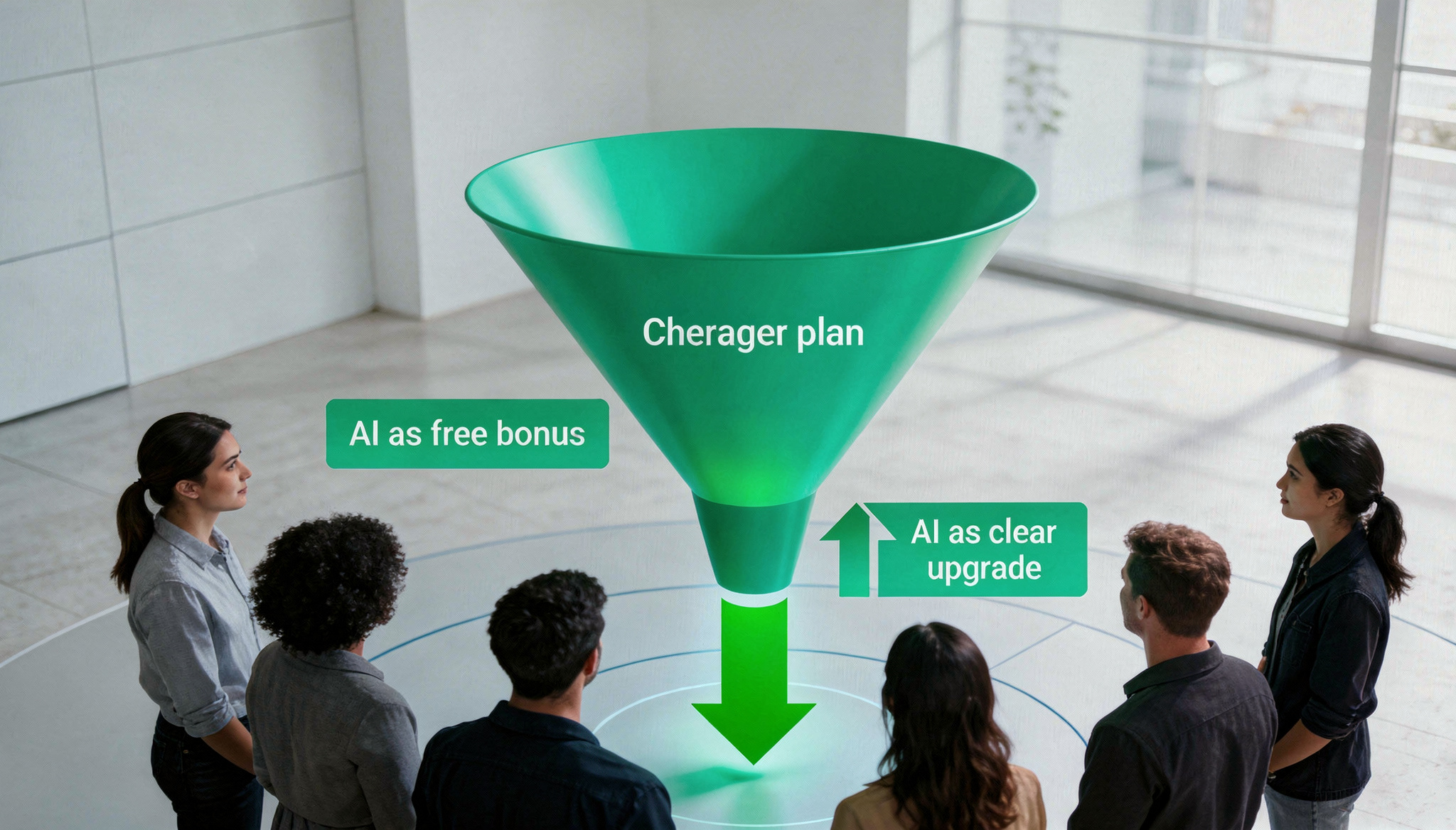
If they see it as a free bonus, a minor add-on, or something that should already be included, the willingness to pay starts to drop before the monetization strategy has even had a chance to work.
One common problem is a simple price spread. When plans are too close together, customers quickly do the math and decide there’s no real reason to move up. If the upgrade feels only slightly different from the current level, the safer option is to stay put.
This issue is even more acute with AI, as many buyers are still learning how to rate it. If the jump is not clear, it chooses a cheaper plan.
Another treats AI as “free sweetener”. This is one of the easiest traps to fall into, especially when teams want quick adoption or feel pressure to show momentum.
But once AI is framed as something extra you get at no extra cost, customers start to see it as part of the baseline. This can make future monetization more difficult, especially as AI incurs real computing and support costs.
The third problem is weaker value differentiation. Some companies integrate AI into plans without being clear about who it is for, what problem it solves, or why it belongs at a higher level.
This leaves buyers staring at a pricing page full of labels, limits and feature lists without a strong sense of what is actually changing for them. And when that happens, the AI starts to feel like a decoration instead of a meaningful reason to upgrade.
Packaging more complex, but the offer does not become more convincing.
There’s a reason so many SaaS vendors have become more cautious in this area. in 2025 68% of SaaS vendors limited AI to premium third-parties, largely to protect perceived value and prevent plan differentiation from collapsing.
This doesn’t mean that every AI feature belongs under the highest paywall, but it again shows that many teams have already learned the same lesson: once AI undermines the value of the core offering, it becomes harder to justify the price.
Align AI features with the right pricing model
One of the reasons AI monetization gets muddled so quickly is that companies treat very different capabilities as if they belong to the same pricing logic, but they don’t.
So before you decide how to sell AI, it helps to rank features by the kind of value they create. This typically results in a better alignment between the product experience and the way customers are billed.
Category 1: Productivity Enhancers (Copilot Style)
These are features that help people move faster through the work they’re already doing, such as:
Features like these improve speed and convenience, but the user still remains in control of the workflow.
This makes this category a natural fit for a premium add-on or mid-tier unlock. Customers see added value, but they’re still paying for an enhanced version of the same workflow, not a fully automated result.
It helps explain why copilot-style AI add-ons were charged for 30% to 110% above the base price per seat in 2025. It also corresponds to how the co-pilots will be are routinely monetized across the market, often through headquarters or pricing according to consumption tied to productivity benefits.
Category 2: workflow automation
These features replace a multi-step manual process with a faster automated flow, such as message generation, anomaly detection or smart routing. The value with them is directly tied to work removed, time saved or throughput gained.
This makes usage-based or outcome-based pricing more appropriate.
As AI does more of the real work, charging by task, output or outcome starts to make more sense. More than 30% of enterprise SaaS solutions embedded results-based pricing by 2025.
Prices according to use SaaS also continues to gain momentum as it aligns costs more with actual consumption and gives customers more flexibility as their needs change.
Category 3: intelligence layers (predictive/agentic)
These are AI capabilities that act more proactively: predictive recommendations, agent functions, and autonomous workflows that perform actions on behalf of the user. They can create significant value, but also bring more uncertainty about usage, costs and pricing.
This is why hybrid pricing is usually the best fit here, with a basic subscription combined with a usage or consumption metric. Mixed models have become the norm in AI software, p 92% of AI software companies that are now using them in some form.
How to create a priced third-party AI that supports upgrades
After choosing a pricing model, SaaS teams must decide where AI fits in their plans. This choice determines whether customers view AI as a clear upgrade or as another confusing layer on the pricing page.
To get started, each plan needs to feel meaningfully different.
Buyers should be able to see:
- what changes at that level
- and why there is a higher price.
When AI is added to an existing plan without this separation, the menu is harder to read. A cleaner structure is “good-better-best-AI” strategy.where the AI sits as a separate layer instead of being pushed into a blueprint that was built for something else.

Add-On approach: low risk, real learning
For many SaaS teams, the add-on provides a clear choice for customers, keeps the core offering intact and creates room to test willingness to pay before changing the entire pricing structure. Add-ons usually take into account 10% to 15% of total revenue and remain one of the least risky ways to introduce new monetization methods.
They also provide teams with better data on adoption, usage, and where AI is creating enough value to justify a bigger change in packaging.
Older existing customers
Price changes tend to create the most friction with customers who are already familiar with your product and plans. That’s why a proper transition is so important. Good access is to lock in the original pricing for a specific period and then move customers to the new model on renewal or expansion.
This protects trust while giving the business time to implement AI packaging more carefully. In addition, it creates a cleaner path for testing new prices on new customers and upsell opportunities first.
Make AI a powerhouse of your core product
It’s true that AI can easily take over the story if society lets it. When this happens, the underlying product underneath can begin to look less valuable.
This is a real risk for SaaS companies. This is also why the platform your customers already trust should remain at the heart of the experience even as AI features are added.
For this they need businesses ensure that their strongest AI functions work silently. They should help users move faster, eliminate repetitive steps, and improve the product without forcing customers to change the way they work.
AI features can quickly spread throughout the market. But what doesn’t spread as easily is the data inside your product, your understanding of the customer, and how your software fits a particular industry or workflow.
For example, a product built based on real customer history, industry needs, and day-to-day workflows carries more weight than a generic AI tool with no business context. That’s the reason companies with stronger data and deeper market knowledge is better positioned to remain valuable as AI becomes more mainstream.
Metrics to tell you if your AI monetization is working
It is possible that the adoption of AI will look impressive without actually improving the business. A feature can get clicks, trials, and lots of internal attention while doing very little for revenue, retention, or margin. Therefore, adoption alone is generally a weak signal.
A better test is whether AI helps the business grow in a healthier way.
Get started with AI attach rate. This shows how many customers are actually paying for AI-enabled plans or add-ons. It gives a clearer picture of monetization than just using features.
Then take a look Maintaining net income. If AI does its job well, customers with AI plans should expand more and stay longer than those without. NRR is one of the clearest ways to tell if new monetization is supporting long-term account growth.
Speed up plan is also essential. How long does it take for a free or basic user to move to the AI level? If this path is too slow, the problem may not be solicitation, but rather poor positioning, poor onboarding, or an offer that still feels optional rather than valuable.
Then there is gross margin an AI plan that cannot be ignored. AI is driving the real cost of delivery, and that’s changing the economy.
AI products often operate closer to 50% to 60% gross margin compared to 80% to 90% for traditional SaaS. So if your AI revenue is growing while margins are quietly shrinking, the model needs attention.

Final thoughts
AI doesn’t have to take away the value from the product that built your business. With the right pricing structure, this product can strengthen, open up new revenue streams and give customers a clearer reason to grow with you.
SaaS companies pushing forward in 2026 are taking AI monetization as a strategic decision. They make deliberate decisions about value, packaging, and pricing, rather than making AI a loose collection of features.
Are you ready to rethink how you package and sell AI features? Let’s talk about what the right monetization model for your product might look like.


Pingback: WWDC 2026 Key Announcements: Ultimate Guide